
VAT in France 2026
French VAT (TVA) comprises a standard rate of 20% and reduced rates of 10%, 5.5%, and 2.1%. This guide explains the most important rules for foreign companies: OSS and cross-border SMEs, reverse charge, VAT import, and e-reporting. If you need instructions on how to obtain a number or reporting instructions, please refer to the separate guides on VAT registration in France and VAT declarations in France.
VAT rates in France 2026 – a complete overview
French VAT rates in 2026 have remained unchanged for many years and are:
- 20% basic rate
- 10%, 5.5% and 2.1% - reduced rates
- exports and IDT may benefit from the exemption while retaining the right to deduct after meeting the appropriate conditions
As you can see, France stands out significantly from other EU countries in terms of the number of VAT rates. While rates in France remain unchanged, the classification of certain services and goods into specific rate categories will change in 2026. This applies particularly to the green energy/renewable energy sector (similar to Belgium) and municipal services.
The table below provides examples of products and services that are subject to specific VAT rates. Data comes from the current French Tax Code and the amendments published in the Loi de finances pour 2026 .
What is the VAT rate in France in 2026? Table
| VAT rate | When to use? (Examples and news 2026) |
|---|---|
| 20% | Standard rate. You apply it to all supplies of goods and services not expressly covered by a reduced rate. Examples: clothing, electronics, cars, alcoholic beverages, confectionery, luxury foods (e.g., caviar, margarine, vegetable fats). |
| 10% |
The rate applies to specific consumer services and certain pharmaceutical products. Medicinal products: Pharmaceutical preparations and medicines with a marketing authorization (AMM), unless they are subject to the 2.1% rate. Culture and art: Occasional sales of works of art by entities using them for their own business purposes. Other: Catering services, passenger transportation, hotel accommodation, firewood. |
| 5,5% | This rate is reserved for basic necessities and pro-ecological investments. For example: Food: Most food products (excluding alcohol and sweets). Medical Devices: Sale and import of equipment for the disabled, insulin syringes, and glucose test strips. Books: Book publishing on any medium (note: from 2026, agendas and calendars are definitively excluded from this rate and subject to the 20% rate). Construction and Renewable Energy Sources (New in 2026): Installation of photovoltaic panels (installer certificate required) and heat pumps. Municipal Services: All services related to the collection and processing of household waste. Housing: Social housing and the provision of land for such development. |
| 2,1% | The rate covers exceptional categories of high social importance. For example, reimbursed medicines: specific medicinal products issued by prescription or under emergency procedures (autorisations d'accès compassionnel). Press: the sale of certain newspapers and periodicals of an informative nature. |
| Sick leave | Exports of goods and intra-Community supplies of goods may benefit from VAT exemption while retaining the right to deduct, provided that material and documentary conditions are met. This is not the separate French VAT rate of 0%. |
Looking for VAT rates for other countries in 2026?
The most important VAT changes in France in 2026
The recodification of VAT regulations and the phased implementation of e-reporting will be crucial in 2026. The scope of a foreign company's new obligations depends on whether it is established in France, its role in the transaction, and who settles French VAT.
A French VAT number alone does not subject a foreign company to the French e-invoicing obligation. However, a non-resident without a registered office or permanent establishment in France may be subject to e-reporting if it carries out transactions taxed in France and is responsible for the French VAT itself.
VAT recodification in CIBS from 1 September 2026.
Effective September 1, 2026, VAT regulations will be transferred from the Code général des impôts to the CIBS. This primarily involves recodification and renumbering. Legal bases in documents must be updated when they actually refer to the amended article.
E-reporting for a foreign company with a FR VAT number
For sellers and service providers, the obligation begins on September 1, 2026, for large companies and ETIs, and on September 1, 2027, for microenterprises, TPEs, and SMEs. Buyers settling WNT or reverse charge transactions enter the system on September 1, 2027, regardless of size. Data is submitted via an approved platform that interfaces with the central directory and PPF infrastructure.
Customs procedure 42
When importing under Procedure 42, non-EU companies must verify the requirements for French VAT identification and a fiscal representative. The change regarding simplified representation is effective from January 1, 2025, not 2026.
Approved Platforms and PPF
Invoices and e-reporting data are to be submitted via approved platforms. PPF primarily serves as a central directory, data routing, and information hub for the administration, rather than a central portal for business services.
Ecotaxes REP and UIN number
E-commerce sellers must verify their environmental obligations. Failure to provide a UIN and data in the system can result in fines, which can reach up to €30,000.
Marketplace and compliance control
Sales platforms will increasingly verify sellers, VAT numbers, UIN data, and billing compliance. Failure to do so may result in a sales account being blocked.
When might a foreign company need a FR VAT number?
Just because you're selling to French customers doesn't mean you need to obtain a local VAT number. First, you need to determine where the goods are located, who the buyer is, and how the delivery process will proceed. The following situations are the most common indicators that a separate registration requirement analysis will be necessary.
Situations that require checking VAT liability
A local VAT number may be needed especially if your business goes beyond simple mail order sales settled in OSS:
A foreign company registers primarily when it is required to settle French VAT and the obligation is not eliminated by appropriate simplification. Detailed procedures, documents, and rules for assigning a number are described in the VAT registration in France section.
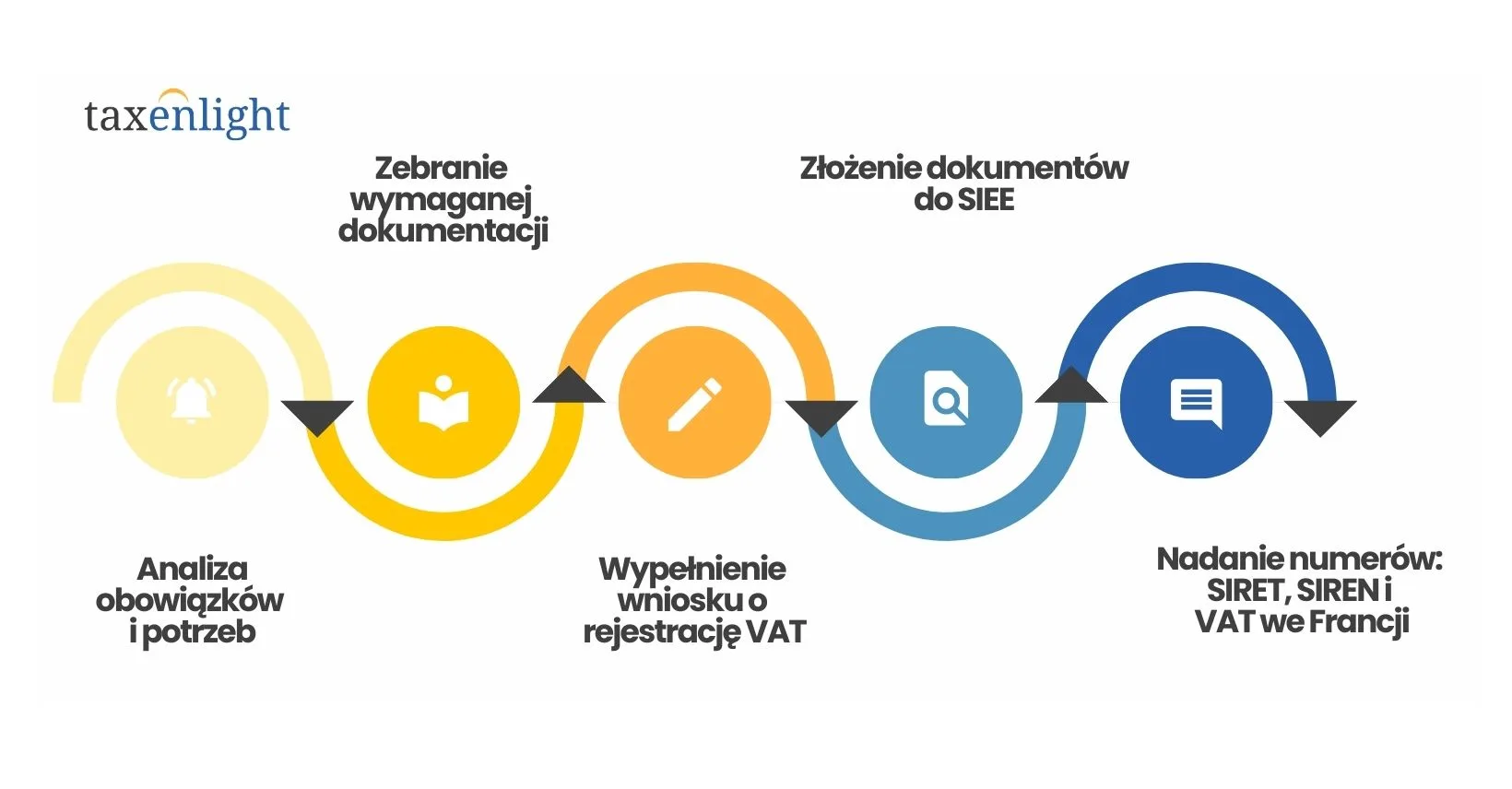
Do you need a VAT number in France?
We'll register you for VAT in France. Contact us or schedule a free online consultation to determine the tax obligations applicable to your sales model.
How does a foreign company settle French VAT?
A company with an active FR VAT number settles its French tax electronically, most often using a CA3 declaration. This declaration reports the VAT due on sales, the VAT charged on purchases, and the amount of tax payable or the excess to be transferred or recovered.
What does a basic VAT settlement include?
The scope of the declaration depends on the type of business and transactions performed in France. The basic declaration includes three elements:
Tax on sales and other transactions that the company is required to tax in France.
Tax on French purchases and imports, which may be deductible if certain conditions are met.
The amount of VAT payable or the surplus remaining to be carried forward or recovered.
Detailed deadlines, reporting frequency, payments and consequences of delays are described in a dedicated guide.
Check out the guide to VAT declarations in France
Want to know when to file CA3 returns, how VAT payments via SEPA work, and what deadlines apply to foreign companies? We've compiled this information into a separate guide to VAT returns in France.
EMEBI and EU transaction reporting
In France, EMEBI obligation does not depend on exceeding the threshold itself. A company must submit a report if it is included in the survey and receives the relevant notification from the French administration.
The French commodity reporting system has undergone a fundamental change. The DEB declaration , which combined statistical and tax data, no longer exists
Statistical data for INTRASTAT are presented in the EMEBI and concern the flow of goods.
Data on EU sales are included in the Etat Récapitulatif TVA, i.e. summary information.
The table below illustrates the separation of duties:
| Characteristic | EMEBI (Statistics) | Etat Récapitulatif (Taxes) |
|---|---|---|
| Who submits? | Only companies designated by letter by the French office | Anyone making deliveries within the EU |
| Where to submit? | DEBWEB2022 Portal | DEBWEB2022 Portal |
| Main goal | Statistical data from goods turnover | Verification of VAT-EU settlements |
| Possibility of facilitations | Manual entry or XML import | Possibility of pre-filling based on data from EMEBI |
When does the EMEBI obligation arise?
The statistical report is submitted by entities selected for the study. Trade in goods itself does not trigger the obligation based on the classic numerical threshold. Reporting is done electronically via the DEBWEB2.
The detailed rules for EMEBI, Etat Récapitulatif TVA and other transaction reports are described in the article on VAT declarations in France.
VAT refund in France – when and how to recover the tax?
As in other EU countries, the refund of French VAT is possible both for companies registered for French VAT and those who make occasional taxable purchases without having a French tax identification number.
VAT refund for companies registered for VAT in France
Any excess VAT resulting from purchases taxed in France is not lost. You can carry it forward to subsequent settlement periods in your VAT return or request a refund to your bank account.
The method for reporting the excess and submitting the claim depends on the tax system. Detailed procedures for recovering the excess are described in our guide to VAT returns in France.
VAT refund for a company not registered in France
If your company is not registered for VAT in France, but you occasionally make taxable purchases, e.g. you bought fuel there during a business trip, you can use the VAT-REF procedure under two directives: 8 and 13.
For companies based in another EU country, the application should be submitted via the administration portal in the country of residence.
For companies based outside the EU, a separate procedure applies for non-EU entities.
E-commerce sales to France and VAT
From 2021, distance sales to France exceeding the EU threshold of €10,000can be settled under the One Stop Shop (OSS). This is a significant simplification, but it does not completely eliminate other tax obligations.
There are certain situations where, even though you are using OSS, you still need to register for French VAT.
When is OSS enough for e-commerce in France?
The EU's OSS (One Stop Shop) procedure allows businesses to sell across the EU without having to register for VAT in the country of delivery. At the same time, French VAT rates apply, and all sales are reported in a single, quarterly VAT-OSS return.
You ship goods from Poland directly to a customer in France
You don't have a warehouse in France
Goods are not moved between EU warehouses
You sell to consumers (B2C)
When do you need a VAT number in France for distance selling?
There are cases where VAT OSS is not sufficient. VAT registration in France is mandatory, even if you use the One Stop Shop procedure, for:
You store goods in French warehouses and sell them locally. These operations qualify your company for a French VAT number. OSS does not cover domestic sales.
If you move goods to France, for example, from a Polish warehouse, you are making a non-transactional supply of goods that you must account for in Poland. On the French side, you must account for a non-transactional acquisition of goods.
When importing goods into France, it is necessary to determine who is the importer and who is responsible for settling VAT. The taxpayer identified for VAT purposes in France settles the import VAT directly in the declaration.
Cross-border SMEs and French VAT
From 2025, a company established in another EU country can apply for an exemption in France under the cross-border SME scheme if it meets, among other things, the EU limit of €100,000, the applicable French limit, and the requirements for prior notification and EX identification. SME can be an alternative to charging French VAT, but it does not automatically resolve obligations related to warehousing, importing, or moving your own goods.
Reverse charge in France - what is it?
Reverse charge can transfer the obligation to settle VAT to the French buyer when the supplier is not established in France, the buyer is properly identified for VAT purposes, and the conditions for the specific transaction are met. The mechanism does not automatically apply to all B2B sales.
The mechanism used depends primarily on the supplier's location, the type of transaction, and the buyer's VAT status. Simply having a French VAT number doesn't mean the supplier is established in France. Therefore, before issuing an invoice, it's important to check the terms and conditions of a specific supply or service.
Examples of reverse charge application in France
Imports and subsequent local sales may be subject to reverse charge if the seller is not established in France and the identified purchaser is liable for the tax.
The mere purchase and resale of goods in France, or the mere possession of a French VAT number, does not constitute a basis for reverse charge. The seller's place of establishment and the buyer's status must be verified.
In the case of B2B services provided by an entity not established in France, reverse charge may apply if, in accordance with the place of supply rules, VAT is settled by the French service recipient.
In construction work, separate conditions apply to subcontractors. A B2B relationship alone is not sufficient to automatically apply domestic reverse charge.
Reverse charge in the construction industry in France
The construction industry has specific reverse charge rules in France. Pursuant to Article 283-2 of the CGI, this mechanism applies when certain conditions are met.
Note: The reverse charge mechanism in France does not apply if you provide services directly to an investor who is not VAT registered, such as a private individual or a VAT-exempt taxpayer. In this case, you must have a French VAT number and charge the French VAT rate on your sales invoice.
| Type of transaction in construction | Who needs a VAT number in France? | Who settles VAT? | Legal basis |
|---|---|---|---|
| A Polish subcontractor provides a service to a French VAT-registered contractor (B2B) | French performer | French contractor applying reverse charge | Art. 283-2 nonies CGI |
| A Polish contractor employs subcontractors and provides construction services to the general investor or contractor (B2B) | Both the French investor or general contractor and the contractor who employs his own subcontractors | The French investor and the Polish contractor settle VAT using the reverse charge mechanism | Art. 283-1 CGI |
| Polish contractor provides construction services to a private individual (B2C) | Polish performer | The Polish contractor issues a standard VAT invoice, charging the French VAT rate | Art. 259 A CGI |
Taxenlight advises: a reverse charge invoice subject to Article 283-2 nonies du CGI must clearly state: Autoliquidation - Article 283-2 nonies du CGI. The absence of this note may be considered a formal error, and the general contractor may refuse to pay the invoice, fearing the impossibility of deducting the tax.
Not sure how to settle VAT in France?
Schedule a free online consultation and find out if you need VAT registration, CA3 declarations, reverse charge or other tax obligations in France.

Adrian Andrzejewski CEO Taxenlight
Import VAT settlement in France
As of January 1, 2022, taxpayers identified for VAT purposes in France will settle their French import VAT directly on their tax return. The import VAT autoliquidation is a mandatory settlement method, not a voluntary relief requiring prior authorization.
Autoliquidation de la TVA à l'importation
As of 2022, the collection of VAT on imports has been transferred from the customs administration to the tax administration. Taxpayers identified for VAT in France will report import VAT on their declaration instead of physically paying it at customs.
No cash payment
When clearing customs in France, you don't physically pay VAT to the customs office. The tax is accounted for in your declaration.
Tax neutrality
You declare the amount of VAT on import both as output tax and input tax, if you are entitled to deduction.
Better financial liquidity
For larger deliveries from China, the USA or the UK, your funds are not frozen at the border, which improves your company's liquidity.
How is import VAT settled in France?
Mandatory import VAT settlement in the declaration requires correct formal preparation. Identifying the importer's VAT and correctly reporting the import in the French VAT return are crucial .
You are importing goods to France
The goods enter France from a non-EU country.
You are using a FR VAT number
To settle import VAT, you need an active French VAT number.
VAT is included in the declaration
Import tax is not paid in cash at check-in.
You calculate and deduct
You show VAT as output and, if the conditions are met, as input.
Important: Before importing, you must determine who the importer is and whether they need a French VAT number. If your company is responsible for paying French import VAT, check in advance whether you need to obtain a French VAT number.
Small shipments: The French €2 per item fee for certain shipments under €150 was in effect from 1 March to 30 June 2026. This fee has been suspended since 1 July 2026 due to the introduction of the EU €3 customs duty. This is a customs issue, not a separate French VAT rate.
Summary - VAT settlement in France
The French VAT system in 2026 provides companies with numerous tools that can improve liquidity and facilitate sales, but it also requires a high level of formal accuracy. The greatest risks typically arise during registration, import, e-commerce sales, reverse charge, and declarations.
What is worth remembering after reading the guide?
If you sell, store, import, or provide services in France, don't judge your VAT obligations solely on a single transaction. In France, the entire sales model often matters: the location of the goods, the type of customer, the delivery method, VAT registration in France, and subsequent reporting.
In the case of import, storage, local sale or certain services, it is necessary to determine who is responsible for accounting for French VAT and whether the obligation is not eliminated by an appropriate simplification.
Once you obtain the number, you need to determine the settlement system, reporting scope, and payment method. Details are provided in a separate declaration guide.
OSS, SME and reverse charge may reduce local obligations, while import VAT is settled directly in the declaration by a taxpayer identified in France.
Taxenlight advises: If you're planning to sell in the French market, it's worth sorting out your obligations in advance: VAT registration in France, VAT returns in France, any OSS settlements, and import obligations. In the next section, you'll find FAQs with frequently asked questions about VAT in France 2026.
FAQ: VAT France 2026 - Frequently Asked Questions
Below you will find short answers to general questions about VAT in France, OSS, SME, reverse charge, import, e-reporting and tax recovery.
How much is VAT in France in 2026?
VAT rates in France are: 20% standard rate and 10%, 5.5% and 2.1% - reduced rates.
What is the cross-border SME procedure?
From 2025, a qualifying company established in another EU country can apply for VAT exemption in France. It must meet, among other things, the EU limit of €100,000, the applicable French limit, and EX declaration and identification requirements.
When do you need to register for VAT in France?
A foreign company may need a French VAT number when it is required to account for French VAT itself, for example, for warehousing, the movement of its own goods, importing, or selling locally. Always check whether OSS, SME, reverse charge, or other appropriate simplifications eliminate this obligation.
How is import VAT settled in France?
A taxpayer identified for VAT in France settles import VAT directly in their VAT return under the TVA's import tax autoliquidation. As of 2022, this mechanism no longer requires prior authorization.
Is a foreign company with a FR VAT number subject to e-reporting?
They may be subject to e-reporting for transactions taxed in France, for which they themselves account for French VAT. However, a French VAT number alone does not subject a non-resident without a permanent establishment in France to the French e-invoicing obligation.
Is reverse charge applicable in France?
Yes, but not for every B2B sale. Reverse charge may transfer the obligation to the identified buyer when the supplier is not established in France and the conditions specific to the transaction are met.
How to get a VAT refund from France?
A registered company recovers the tax through its French VAT return. An EU company not registered in France may use the VAT-REF, while a non-EU entity may use a separate refund procedure.
What is the distance selling threshold in France?
From 2021, a common EU limit of €10,000 to certain B2C sales. Above this limit, French VAT can usually be settled through an OSS; a local number may be needed if your sales model extends beyond the OSS.
If I have goods in an Amazon FBA warehouse in France, do I need a French VAT number?
Storing goods in France is a strong indicator of VAT liability in France, as OSS does not cover own goods movements or domestic sales. Before starting FBA, it's important to analyze local obligations and possible simplifications.