
VAT rates in the European Union 2026
EU VAT rates in 2026 vary by country, product or service category, and transaction type. This table helps you quickly check the standard and reduced VAT rates in European Union countries.
The list is particularly useful for companies settling VAT OSS declarations, cross-border sales and VAT declarations abroad.
EU VAT rates 2026: current table
The table includes standard, reduced, super-reduced, and selected special VAT rates in European Union countries. The data is particularly useful for B2C sales, OSS billing, and rate configuration in marketplaces and accounting systems.
| Country | Country code | Standard | 1. reduced | 2. reduced | Super reduced |
|---|---|---|---|---|---|
| Austria | AT | 20% | 13% | 10% | 4,9% |
| Belgium | BE | 21% | 12% | 6% | — |
| Bulgaria | BG | 20% | 9% | — | — |
| Croatia | HR | 25% | 13% | 5% | — |
| Cyprus | CY | 19% | 9% | 5% | — |
| The czech republic | CZ | 21% | 12% | — | — |
| Denmark | DK | 25% | — | — | — |
| Estonia | EE | 24% | 13% | 9% | — |
| Finland | FI | 25,5% | 13,5% | 10% | — |
| France | FR | 20% | 10% | 5,5% | 2,1% |
| Greece | EL | 24% | 13% | 6% | — |
| Spain | ES | 21% | 10% | 4% | — |
| Netherlands | NL | 21% | 9% | — | — |
| Ireland | IE | 23% | 13,5% | 9% | 4,8% |
| Luxembourg | LU | 17% | 14% | 8% | 3% |
| Lithuania | LT | 21% | 12% | 5% | — |
| Latvia | LV | 21% | 12% | 5% | — |
| Malta | MT | 18% | 7% | 5% | — |
| Germany | DE | 19% | 7% | — | — |
| Poland | PL | 23% | 8% | 5% | — |
| Portugal | PT | 23% | 13% | 6% | — |
| Romania | RO | 21% | 11% | — | — |
| Slovakia | SK | 23% | 19% | 5% | — |
| Slovenia | AI | 22% | 9,5% | 5% | — |
| Sweden | SE | 25% | 12% | 6% | — |
| Hungary | HU | 27% | 18% | 5% | — |
| Italy | IT | 22% | 10% | 5% | 4% |
Note: The table shows the main rates. The scope of application of reduced rates depends on local regulations and the product or service category.
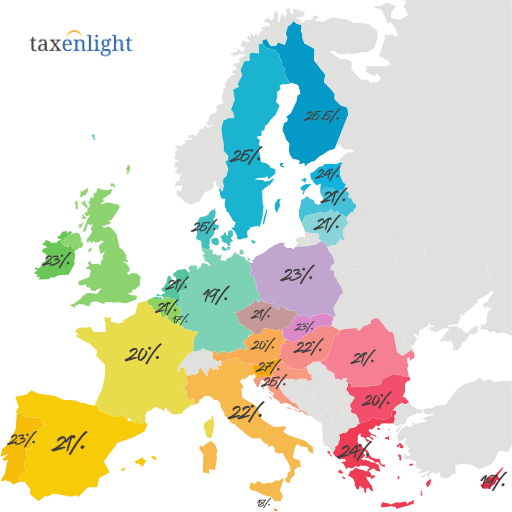
2026 EU VAT rates - interactive map
Check the standard VAT rates for European Union countries on a map. This is a quick way to compare tax burdens between countries and determine which rate to apply when selling cross-border.
EU VAT rate changes: 2025 and updates from March 2026
Some of the changes introduced in 2025 will also apply in 2026, and further sector-specific and time-specific changes have been introduced since March 2026. For businesses, this means updating rates in sales systems, marketplaces, cash registers, and OSS billing tools.
Slovakia
The standard VAT rate is 23%. Reduced rates of 19% and 5%.
Estonia
The standard VAT rate is 24%. The table also includes reduced rates of 13% and 9%.
Romania
The standard VAT rate is 21%and the main reduced rate is 11%.
Changes to VAT rates in the EU from March 2026
The changes below do not always represent a change to the standard VAT rate in a given country. In many cases, they apply to selected industries, specific categories of goods or services, or are temporary in nature.
If you sell to multiple EU countries, the basic rate table alone isn't enough. Sector-specific changes may impact rate configuration in your online store, marketplace, invoicing system, cash register, and OSS VAT settlements.
Belgium: accommodation and plant protection products
From 1 March 2026, the VAT rate for selected furnished accommodation services and camping pitches has increased from 6% to 12%. Phytopharmaceutical products and pesticides are generally subject to a 21% instead of 12%.
Spain: Temporary 10% rate for energy and fuels
From 22 March to 31 May 2026, Spain applied a temporary 10% VAT rate to certain supplies of electricity, natural gas, biomass briquettes and pellets, firewood and certain types of petrol, diesel and biofuels.
The application of preferences in June was contingent on changes in the IPC indicators. The statutory conditions were not met, so the 10% rate ceased to apply from June 1, 2026. This is not the current rate.
Poland: Temporary VAT reduction on certain fuels
From March 31, 2026, to April 30, 2026, Poland temporarily reduced VAT on certain motor fuels to 8%. The reduction did not apply to products used for heating purposes, which remained at 23%.
Austria: 4.9% VAT on selected basic food products
As of July 1, 2026, Austria will apply a 4.9% to selected basic food products. This change is important for stores, cash registers, and sales systems, as the new rate must be reported on sales documents.
Ireland: 9% for catering and hairdressing
From July 1, 2026, a second, reduced rate of 9% applies to services such as restaurant and catering services, hot takeaway meals, hot tea and coffee, and hairdressing services. Previously, a 13.5%.
Latvia: 12% on selected basic food products
From July 1, 2026, to June 30, 2027, Latvia applies a 12% to selected basic food products, including bread, milk, poultry, and eggs. This is a time preference.
How to read this update?
The changes from March 2026 should be considered a supplement to the EU VAT rate table. The table shows the main rates in a given country, but for a specific product or service, it is always necessary to check whether a specific reduced, time-based, or industry-specific rate applies.
VAT rates in the EU and VAT OSS
Under the VAT OSS , the seller settles B2C sales to other EU countries in a single declaration, but applies the VAT rate of the country of consumption. This means that when selling to multiple countries, the rates for each country must be correctly assigned.
As a rule, the rate of the country of establishment can be applied if B2C sales to other EU countries do not exceed the combined threshold.
You must use the VAT rates of the recipient countries and settle sales through OSS or local VAT registrations.
If you store goods in another EU country, the OSS procedure alone will not usually replace local VAT registration abroad.
VAT OSS and VAT rates – example
A Polish company sells products to consumers in Germany and France. Above the €10,000 threshold, it should apply the appropriate rates in the recipient country: for example, 19% German or 20% French, unless the product category in question benefits from a reduced rate.
How are VAT rates determined in the European Union?
The European Union establishes the framework for the VAT system, but the specific rates are set by the Member States. Therefore, there is no single common VAT rate within the EU, and the rate tables must be regularly updated.
The basic principles stem from Directive 2006/112/EC. It establishes a framework for standard rates, reduced rates, and exceptions.
Each EU country determines the list of goods and services covered by reduced rates, within the limits of EU law.
When selling in the EU, it is worth using official sources, such as the Your Europe website about VAT rules.

Do you sell to several EU countries?
We help you determine the correct VAT rates, select an OSS or local VAT registration, and organize your settlements in EU countries. This is especially important if you sell through a marketplace, store goods abroad, or have multiple product categories.
VAT rates in the EU 2026 – the most important conclusions
Each country has its own rates, so when selling internationally, knowing one country's rate is not enough.
Once the B2C sales threshold of EUR 10,000 is exceeded, the VAT rates of the recipient country must be applied and correctly reported in the OSS.
Just because a country has a reduced rate does not automatically mean that it covers a given product or service.
Rates need to be updated across stores, marketplaces, invoicing, and accounting systems to avoid adjustments and backlogs.
VAT rates in the EU 2026 - FAQ
Yes. The OSS VAT return applies the rates of the country of consumption, i.e., the recipient country. The table helps you check the basic rates, but for a specific product, you need to confirm whether a reduced rate applies.
Yes. Member States can change VAT rates throughout the year. Therefore, companies selling to multiple countries should regularly update their sales and accounting systems.
It's safest to use official sources from the European Commission, local tax administrations, and current expert studies. For unusual goods, it's worth checking local classifications.
This is an exceptionally low VAT rate applied only in selected countries and for limited categories of goods or services. Not every EU country has this rate.
Most often, after exceeding the total threshold of EUR 10,000 of B2C sales to other EU countries or after voluntarily choosing to settle sales according to the rules of the country of consumption.
Yes. Registering for VAT OSS can be voluntary. This is convenient for some companies, as it allows them to apply the recipient country's rates from the outset and avoid changing their settlement model mid-year.
Incorrect rates can lead to declaration corrections, additional tax payments, interest, penalties, and problems with the OSS process. The risk increases with a large number of transactions and marketplace sales.
Yes. Digital and electronic services provided to consumers in the EU are generally taxed in the country of consumption and may be accounted for through VAT OSS.