VAT in Belgium 2026

  • To whom do we dedicate the article?: E-commerce companies that sell goods to Belgium (B2C sales, B2B sales, warehousing), companies that make local transactions in Belgium settle the sales through VAT OSS; B2B/B2C service providers.
  • Current regulations as of January 2026: There were no changes in VAT rates compared to 2025. However, some sectoral corrections (including in hotel and catering services) result from legislative actions planned for the beginning of 2026 and are specified in separate announcements and implementing regulations.

Do you need the support of a tax representative in Belgium?

Contact us for a free consultation.
We'll analyze your tax obligations

Adrian Andrzejewski Taxenlight

VAT rates in Belgium 2026 – full overview

VAT rates in Belgium  remain unchanged in 2026. However, according to the latest report from the Budget Monitoring Committee is changing residential construction and the sale of heat pumps in Belgium

In addition, from 1 March 2026, further changes to the classification of rates are planned in Belgium in the following areas:

  • Services related to hotels, campsites, recreational facilities will be subject to a rate of 12%
  • Sports, culture and entertainment services will be subject to a 12% rate
  • Takeaways and soft drinks will be subject to a 12% rate
  • Pesticides will be subject to a 21% rate

Current VAT rates in Belgium and the product and service groups subject to them can be found in the table below. The table will be updated when the above changes come into effect in March 2026. Detailed administrative interpretations are still being finalized and may affect the final classification of services and goods.

Type of VAT rate in BelgiumWhen to use?
Standard – 21%This is the normal VAT rate that applies to all goods and services not expressly listed as being subject to reduced rates in the Royal Decree (20) in Tables A and B. In 2026, fossil heating boilers fuel the supply of fossil coal .

Reduced – 12%Restaurant and catering services (excluding beverages); Margarine; Certain plant protection products; Certain agricultural tires and inner tubes; construction work (renovations, renovations) and leasing of real estate intended for social purposes, if carried out for specific institutions. Construction of buildings, their renovation and property rights in real estate intended for rent to recognized entities operating within the framework of housing policy.
Reduced – 6%Heat pumps; demolition and reconstruction of buildings; live animals (cattle); Meat and fish excluding caviar, lobsters, crabs, lobsters and oysters; Dairy and animal products (milk, yogurts, butter, cheeses, eggs, natural honey); Plant products (vegetables, fruits, cereals, oilseeds, medicinal plants, sugar beet, straw and feed); Processed food products; Water supply through waterworks; Medicines and medicinal substances (Pharmaceutical products registered as medicines, blood, plasma, preparations prepared by pharmacists). Medical devices (Cotton wool, gauze, bandages, first aid kits); Equipment for disabled people (wheelchairs, prosthetics, hearing aids, glucose meters, infusion pumps, special aids for the blind, cars adapted for the transport of disabled people); Hygiene products (sanitary pads, tampons); Press and books (newspapers, magazines, books, e-books - unless they are mainly used for advertising, children's albums, sheet music, maps and atlases); Admission to venues (cinema, theatres, concerts, museums, zoos, amusement parks, sports facilities excluding slot machines); Art: Some works of art, collectors' items and antiques; Construction and renovation (of private homes, social housing under certain conditions); Passenger transport; Hotel services, some agricultural services.
VAT rate – 0%Exports, intra-Community supplies of goods, certain types of press; certain types of international transport
VAT exemptionEducational services (including school construction), medical, social, non-profit institutions, financial services, some real estate services

Check VAT rates across the EU for 2026 (table)

VAT registration in Belgium – when is it mandatory?

Non-residents, meaning businesses without a permanent establishment in the country, must register for VAT in Belgium. While Belgian law allows VAT registration retroactive

In our experience, a Belgian VAT number is issued within 3 to 6 weeks.

Below, we'll explain when a Belgian VAT number, how the registration process works, and how long it typically takes.

VAT number in Belgium – what does it look like?

In Belgium, there are two types of tax numbers, each with an identical numerical structure. They differ only in the VAT prefix:

  • The Belgian KBO/BCE number  (Kruispuntbank van Ondernemingen / Banque-Carrefour des Entreprises) is the equivalent of the Polish Tax Identification Number (NIP). It is assigned to every company registered in the Belgian trade registers. It is used to identify the company in local transactions (excluding VAT) in Belgium. It consists of 10 digits.
  • Belgian VAT number (TVA) – this is the same KBO/BCE number with the only difference being the BE prefix, e.g. BE0999999999. This number authorizes the taxpayer to conclude VAT and EU transactions.

Non-residents planning to operate in Belgium must first obtain a local KBO/BCE numberand only then apply for VAT activation.

When do you need to get a VAT number in Belgium?

Below is a list of situations that require you to have a Belgian VAT number and settle VAT in Belgium:

  • Distance selling (e-commerce) to consumers, after exceeding the total EU threshold of €10,000 (if you do not use VAT OSS)
  • Selling and purchasing goods locally
  • Storage of goods in a Belgian warehouse (FBA, consignment warehouse, call-off stock)
  • Exporting goods from Belgium to a country outside the European Union
  • Import of goods into Belgium from a country outside the European Union for resale
  • Using the deferred VAT import procedure in Belgium (License ET 14 000)
  • Intra-Community transactions: intra-Community supplies and intra-Community acquisitions
  • Non-transactional deliveries and purchases of goods (transfers of goods between foreign warehouses)
  • Organisation of conferences and exhibitions in Belgium
  • The provision of specific services subject to Belgian VAT, without the application of the reverse charge mechanism. These are exceptions, as the general rule set out in Article 44 of the EU VAT Directive applies in Belgium.

What is the VAT registration process like in Belgium?

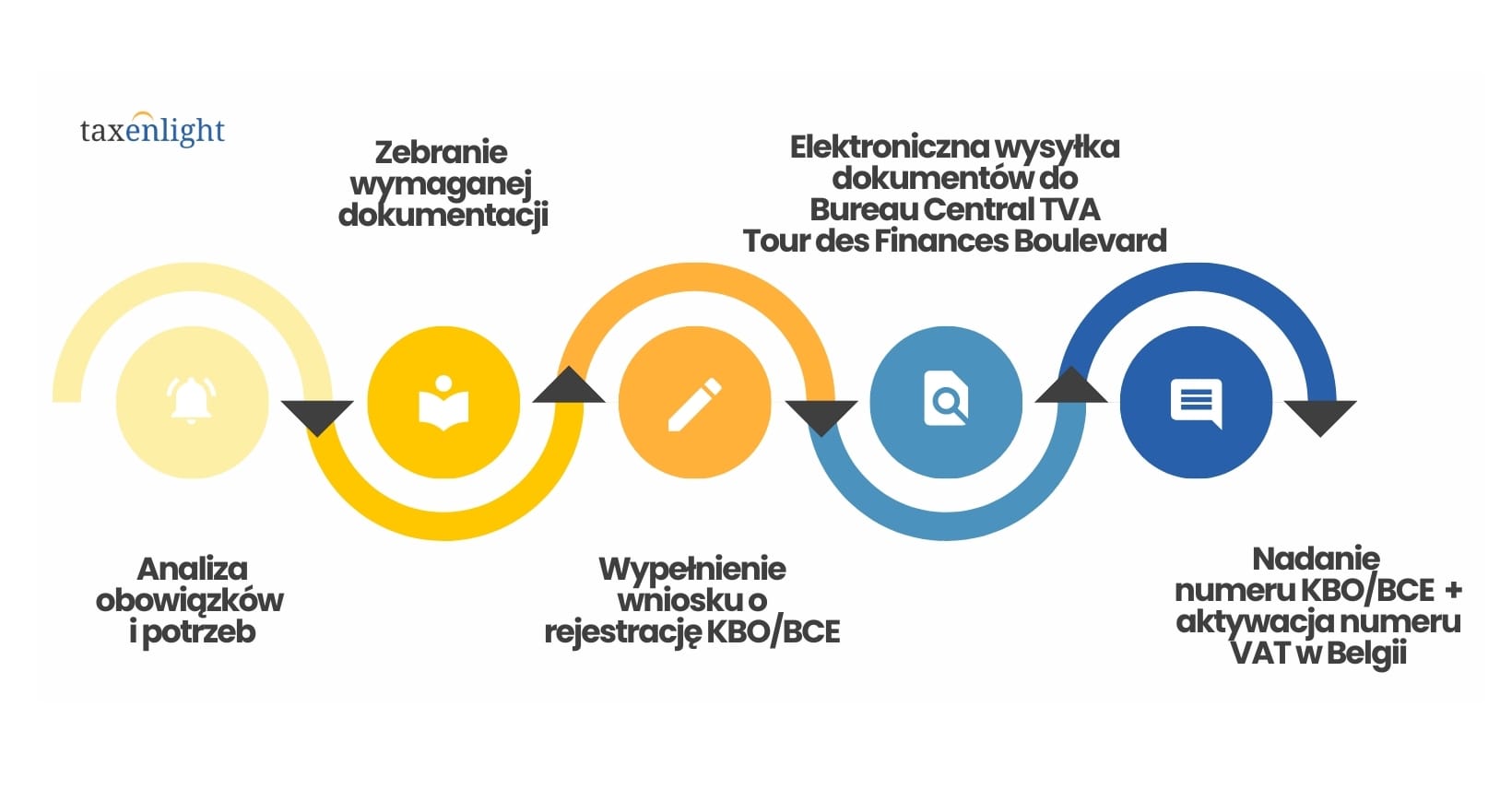
The VAT registration process in Belgium follows a strictly defined procedure and comprises several sequential steps. First, you must determine whether your planned business is subject to VAT in Belgium. If so, you must obtain a KBO/BCE tax number from the Belgian Business Register.  

The next step is to apply for VAT activation before starting your business. Once your application is approved, your KBO/BCE number will be activated as a VAT number in Belgium.

VAT registration in Belgium VAT registration process in Belgium - infographic

What documents are required for VAT registration in Belgium?

To obtain a VAT number in Belgium, the following documents are required, among others:

  • Identification document (passport or ID card)
  • Company documents (company agreement, statute, etc.)
  • Extract from the commercial register
  • Confirmation of the VAT number assignment in the country of residence
  • Bank account details in EUR
  • Application for a VAT number in Belgium
  • Power of attorney – if you outsource VAT compliance services in Belgium to a specialized company.

Check detailed information about VAT registration in Belgium in a dedicated guide

Tax representative and attorney in Belgium – is it required?

The need to appoint a tax representative depends on where your business is located:

  • Based outside the EU: you are required to appoint a tax representative who will be jointly responsible for your tax settlements in Belgium.
  • Based in an EU country: There is no requirement to have a tax representative. However, you can voluntarily use the services of a representative to ensure peace of mind and tax security in Belgium.

Do you need a VAT number in Belgium?

VAT returns in Belgium - settling taxes in Belgium

If you've just received a Belgian tax number, you should be aware that, in addition to your rights to conduct transactions under the Belgian tax system, you also have a number of obligations. The most important of these is settling VAT in Belgium, which means filing periodic VAT returns, the EC Sales List (EU VAT), and Listing Clients.  So, let's take a step-by-step look at your specific tax obligations in Belgium and the deadlines that apply to you.

VAT declarations and VAT payments in Belgium – frequency, deadlines, penalties

VAT returns in Belgium Every company that is not a Belgian resident (does not have a registered office in Belgium) must file Transaction reporting is only possible electronically.

Filing VAT returns in Belgium monthly is the general rule – most companies settle their Belgian taxes on this basis. However, in exceptional cases, quarterly settlement, provided the following conditions are met:

  • Your company's annual net turnover does not exceed the threshold of EUR 2,500,000
  • Your company's annual net turnover does not exceed the threshold of EUR 250,000 for the supply of products such as:
    – Energy products (used as fuel, e.g. diesel fuel)
    – Mobile telephone devices, computers (and their accessories and components)
    – Land vehicles equipped with engines subject to registration regulations

Filing quarterly VAT returns in Belgium is therefore only possible for certain companies, e.g. in the construction sector, as long as they do not exceed the thresholds.

VAT Declarations Belgium Types of Tax Declarations in Belgium

Filing a return in Belgium – what determines the pace? Example:

  • If the company "AB" has an annual turnover of EUR 2,200,000 and EU supplies of EUR 40,000,  it can submit quarterly declarations.
  • If the company "CD" has an annual turnover of EUR 2,200,000 but EU supplies of EUR 70,000, it must submit monthly declarations.
  • If the company "EF" sells vehicles and has an annual net turnover of EUR 300,000 → it must submit monthly declarations

Deadlines for submitting VAT returns in Belgium:

From 2025, the deadlines and rules for submitting VAT returns in Belgium have been updated, especially in the context of quarterly reports, and are as follows:

  • Monthly declarations – by the 20th day of the month following the settlement period. If the 20th day falls on a weekend or public holiday, the deadline is extended to the next business day (so-called tolerance permanente).  This rule applies permanently to monthly declarations in Belgium.
  • Quarterly returns – by the 25th of the month following the settlement period. Unlike monthly VAT returns, when the deadline for filing a VAT return in Belgium falls on a weekend or public holiday, the deadline is not extended to the next business day.

These deadlines are the same for VAT payments in Belgium. VAT payments in Belgium are made directly to the account of the Belgian tax administration. When submitting a VAT return, a unique payment reference is generated, which must be included during the transfer so that the tax office can correctly link the payment to the VAT return.

Check detailed information about VAT declarations in Belgium in a dedicated guide

Ec Sales list declaration – the equivalent of the EU VAT report

The EU declaration in Belgium, referred to by the general EU name Ec Sales List and in Belgium specifically relevé intracommunautaire, contains a list of all intra-Community transactions for VAT payers from other European Union countries.

An Ec Sales List declaration in Belgium must be submitted by every company with a valid EU VAT number if it has completed at least one EU transaction. EU reports in Belgium are submitted in two rhythms, with stricter limits:

  • Monthly Ec Sales List declarations in Belgium – submitted by companies with a net value of more than EUR 50,000 in intra-Community supplies of goods. The deadline for submitting the declaration is the 20th day of the month following the accounting period.
  • Quarterly Ec Sales List declarations in Belgium – submitted by companies that make occasional intra-Community supplies that do not exceed the threshold of EUR 50,000. The deadline for submitting the declaration is the 20th day of the month following the accounting period.

If you have not made any EU transactions in a given period, a zero declaration of the Ec Sales list in Belgium is not required.

Listing Clients - Annual Summary Declaration in Belgium

Companies conducting domestic B2B transactions in Belgium must submit an annual declaration, the so-called Listing of Clients, known as the "Liste annuelle des clients assujettis à la TVA." This declaration is required when the net value of such transactions exceeds EUR 250.

The Belgian Client Listing declaration must be filed electronically, no later than March 31st of the year following the tax period. If no domestic B2B transactions occurred in a given year, the taxpayer is required to file a zero listing. Failure to comply with the obligations related to filing the annual statement in Belgium may result in administrative penalties.

Would you like to outsource the submission of VAT declarations, Ec Sales List,
Listing clients in Belgium?

Table – What are the tax penalties in Belgium?

In Belgium, penalties for failing to submit VAT returns on time are automatically calculated on a pro rata basis. The same applies to VAT payments. The calculation method has been updated as of January 1, 2025, and is presented in the table below:

Type of violationRate/percentage according to SPF Finances (after changes 2025)
No periodic VAT declaration (or late)From EUR 100 to EUR 5,000 depending on the seriousness of the offence + additional sanctions, including the obligation to submit a so-called substitute declaration
VAT paid after the deadline, but declaration submitted on time5% of the amount of VAT due
VAT paid after the deadline, declaration late10% of the amount of VAT due
VAT resulting from the so-called substitution declaration (substitution définitive)15% of the amount of VAT due
Interest on late payment of VAT0.8-0.9% of the VAT amount due, calculated automatically from the first day
No EC Sales List declaration (or late)From EUR 75 to EUR 3,000 if the taxpayer still fails to submit the declaration despite the requests
No Listing Clients declarationFrom 50 to 3,000 EUR (AR 44 fines, with the possibility of reduction under the "bonne foi" policy)

INTRASTAT declarations in Belgium – thresholds, deadlines, penalties

Intrastat declarations in Belgium must be submitted by any company that exceeds the Belgian INTRASTAT thresholds for arrivals or departures in a given calendar year. Data on obligations and deadlines is published by the Belgian Central Bank, which operates the OneGate INTRASTAT system. For 2026, the Belgian INTRASTAT thresholds remain unchanged and are as follows:

  • INTRASTAT limit in Belgium for arrivals: EUR 1,500,000
  • INTRASTAT limit in Belgium for exports: EUR 1,100,000

The deadline for submitting the INTRASTAT declaration in Belgium is the 20th business day of the following month (e.g. for January 2026, you must submit the INTRASTAT declaration by February 20, 2026).

If the INTRASTAT declaration is not submitted within the statutory deadline, the Belgian Statistics Office may impose a fine ranging from EUR 100 to even EUR 10,000.

VAT e-invoicing in Belgium from 2026

From January 1, 2026, Belgium will introduce mandatory electronic invoicing (e-invoicing) for B2B transactions between VAT payers. This change is a key element of the VAT system's digitalization and is consistent with the EU's direction outlined in the VAT in the Digital Age (ViDA).

E-invoicing means that traditional paper invoices and PDF invoices sent by email will not be recognised as valid VAT invoices in B2B relationships covered by the obligation.

Who is covered by the e-invoicing obligation in Belgium?

The e-invoicing obligation in Belgium includes:

  • VAT payers with their registered office or permanent establishment in Belgium
  • transactions between Belgian VAT payers
  • sale of goods and provision of services subject to VAT in Belgium

Importantly, this obligation does not, in principle, cover non-residentswho:

  • they do not have a registered office or permanent place of business in Belgium
  • are registered for VAT in Belgium only as companies based in another country

Real Time Reporting of transactions in Belgium

The introduction of mandatory e-invoicing in Belgium is not an end in itself. It is the first step in a broader reform, the next step of which will be real-time VAT reporting in Belgium. This system will result in the automatic transfer of invoice data to the tax office, thus shortening the time between a transaction and its reporting. Real-time reporting in Belgium will reduce manual corrections and late filings. date for the introduction of real-time reporting in Belgium when it becomes available We will update this article

VAT refund in Belgium – when and how to recover the tax?

VAT deduction in Belgium  is only possible for purchases that are directly related to your business activities in Belgium. VAT recovery in Belgium is possible in the following ways:

  • If you have an active VAT number in Belgium , you can transfer VAT to the next settlement period or, when submitting your declaration, select the option that you want to obtain a VAT refund.
  • If you are based in the EU but do not have an active VAT number in Belgium , you submit a refund application via the VAT-REF procedure (the so-called 8th Directive 2008/9/EC) to the tax office where you are based. Applications can be submitted until September 30th of the year following the year in which you made your taxable purchases.
  • If you are based outside the EU , you can apply for a VAT refund based on the 13th Directive (the procedure is described in detail in Belgium 13th Directive VAT refunds).

If you are applying for a VAT refund in Belgium "externally" (via the 8th or 13th Directive), remember that in order for the VAT refund application to be accepted by the tax office, the invoices must be correctly issued and contain all the required data.

Key conditions for deducting VAT in Belgium in the VAT return:

  • Invoices must be issued to your company name and relate to goods or services purchased in Belgium. The invoice must include all the necessary elements detailed in Belgian regulations, Article 5 AR No. 1.
  • The deduction is made in the VAT return for the period in which the right to deduct arose (generally at the time when VAT became due and the taxpayer acquired the invoice)
  • The taxpayer must have settled his tax liabilities and submit his Belgian VAT returns on time to avoid having his VAT refund suspended.
  • The minimum VAT refundable in Belgium is €50.

Mail order sales to Belgium (e-commerce) and VAT

Since July 2021, a special EU One Stop Shop (OSS) scheme, significantly simplifying distance selling. If you want to sell goods by mail order to Belgium, you no longer need to register for VAT in Belgium. If you are based in an EU country (e.g., Poland), you can register locally for One Stop Shop and easily conduct distance selling (OSS) to Belgium.

Up to a distance selling limit of €10,000 (total sales to all European Union countries), you can ship goods from Poland to Belgium at the Polish VAT rate. However, after this threshold, you must register for VAT in Belgium or use the OSS procedure.

However, considering the lower VAT rate in Belgium (21%) compared to Poland (23%), even voluntary registration for VAT OSS is possible for you and very financially advantageous.

When do you need a VAT number in Belgium for distance selling?

If you plan to store your goods in a warehouse in Belgium and ship them to customers from there, you must register for VAT in Belgium. The mere act of moving goods from Poland to a Belgian warehouse triggers your tax liability in Belgium.

Such an operation, treated as a so-called non-transactional supply of goods, should be reported in Poland as an intra-Community supply of goods (ICS)and simultaneously in Belgium as an intra-Community acquisition of goods (ICS) in the local VAT declaration.

In your Belgian VAT returns, you will then also include domestic B2B and B2C sales, intra-Community supplies of goods (ICS) to other EU countries, and exports of goods outside the European Union, if such transactions occur.

Importantly, you can still use the One Stop Shop (OSS)if you sell goods from a warehouse in Belgium to consumers in other EU countries. In this case, you will account for B2C sales to other member states in your quarterly OSS return filed in Poland, even though the goods are physically shipped from Belgium.

Sounds complicated?

Contact us for a free consultation.
Let's discuss your obligations
in Belgium

Goods warehousing in Belgium – a key logistics base for e-commerce and Amazon FBA

Belgium boasts a wide range of e-commerce logistics warehouses, including modern fulfillment centers, which are particularly attractive to Polish sellers using Amazon FBAplay a significant role Amazon fulfillment centersand third-party 3PL, enabling the rapid distribution of goods throughout the European Union.

What types of warehouses are there in Belgium for e-commerce?

Belgium has an extensive warehouse infrastructure adapted to various business needs:

  • Bonded warehouses (public and private) – for storing goods before customs clearance
  • Fulfillment Centers  – e.g. Amazon FBA – crucial for e-commerce and multi-channel sales
  • Distribution centers – for handling large B2B and B2C volumes (so-called 3PL operators), which offer integration with sales platforms (e.g. Amazon) along with packaging and shipping services
  • Cross-docking – for quick reloading and further shipment
  • Specialist warehouses – for dry food products

Amazon FBA warehouses in Belgium

Amazon has two main fulfillment centers in Belgium:

  • DBG2 – Antwerp (Address: D'Herbouvillekaai 70, Antwerp)
  • EBLG – Grâce-Hollogne (Address: Rue Saint-Exupéry 14, Grâce-Hollogne)

Both locations serve as sorting centers for shipments from France and Germany, as well as handling local deliveries within Belgium. As part of the Pan-European FBA , goods shipped from Poland can be automatically redistributed to these hubs, eliminating the need for manual inventory relocation planning.

Other 3PL providers in Belgium for e-commerce

In addition to Amazon, there are several important fulfillment operators for online stores in Belgium:

  • Webship – approximately 4,000 m² of warehouse space, integration with sales platforms, full logistics service: warehousing, packaging, shipping, returns handling
  • ShipBob – logistics solutions for e-commerce brands, scalable infrastructure in Belgium, fast distribution throughout the EU.
  • FLEX – a 3PL operator enabling integration with Amazon SPN, FBA prep and handling shipments to Amazon centers.

Reverse charge in Belgium – B2B services, exceptions and VAT obligations

The reverse charge in Belgium is a mechanism whereby the obligation to account for VAT is transferred from the seller to the buyer of goods or services. The main Belgian regulations governing this mechanism are:

  • Article 51 § 2 of the Belgian VAT Code, which specifies the liability for payment of tax.
  • Articles 20 of Royal Decree No. 1, which specifically regulate the reverse charge in relation to specific goods and services, such as construction works, gold or CO2 emission allowances.
  • Royal Decree No. 57, which concerns the place of supply of services based on their actual use (the "Use and Enjoyment" rule of 2023).

When can the reverse charge be applied in Belgium?

The Belgian reverse charge system follows the general rules of VAT Directive 2006/112/EC, but Belgium has further extended the reverse charge rules. This mechanism applies in the following cases:

  • Use and Enjoyment principle: Belgium applies this principle to avoid double taxation or non-taxation, which allows Belgium to be considered as the place of supply of services (e.g. transport) if they are actually used there.
  • Foreign suppliers (Article 194 of the Directive): Applies when a foreign supplier (not established in Belgium and not having a VAT number there) supplies goods or services to a customer who is registered for VAT in Belgium or is registered through a tax representative.
  • B2B Services (Article 196 of the Directive): As a general rule, any company not established in Belgium that provides services to a customer registered in Belgium does not charge VAT – the tax is settled by the buyer. The service provider is not registered for VAT in Belgium.

Reverse charge mechanism in Belgium – which industries are obliged to apply it?

In Belgium, the reverse charge procedure is mandatory in specific industries to prevent tax fraud. These include:

  • Provision of construction services (construction work). This includes construction services on real estate and the provision of workers for such work. From 2023, this mechanism applies whenever the purchaser of the service has a Belgian VAT number and submits periodic declarations.
  • Gold delivery. The reverse charge mechanism must be applied to gold with a purity above 32.5%, as well as investment gold.
  • CO2 emission allowances. The transfer of CO2 emission allowances is subject to the reverse charge, provided the customer has a Belgian VAT number and submits periodic declarations.
  • Transport and related services. These include services such as loading, unloading, and packaging, provided that the geographical criteria resulting from the principle of effective use are met.

When can reverse charge not be applied in Belgium?

The reverse charge mechanism in Belgium does not apply in the following situations:

  • Direct VAT registration of the customer: In the case of the general mechanism for foreign entities (Article 194), the reverse charge does not applyin Belgium directly and submits VAT returns.
  • Customers not filing declarations: In the construction industry, the mechanism does not apply if the customer has a VAT number but is not obliged to file periodic tax returns (is exempt).
  • B2C transactions: The reverse charge applies only to business-to-business (B2B) transactions. When providing services to private consumers, the reverse charge does not apply.  
  • Specific types of services: Excluded from the general B2B rule are, among others, short-term rental of means of transport, catering services and admission to events (trade fairs, conferences), where the place of taxation depends on the location of the event or resource.
  • Warehousing Services: The storage of goods itself is not considered a transport-related service and is excluded from the Use and Enjoyment mechanism.

Deferred Import VAT in Belgium – License ET 14,000

In Belgium, it's possible to apply for deferred import VAT by obtaining an ET 14 000 license. This allows you to import goods into Belgium without having to pay import VAT at the border upon arrival. This improves your company's cash flow by accounting for import VAT in your periodic VAT return.

The provisions related to the deferral of import VAT are regulated by the following regulations: Circulaire: AGFisc no. 25/2013 of 27/06/2013 (ET 123.777).

What is the ET 14,000 License in Belgium?

The ET 14 000 license allows for the deferment of import VAT payments until the VAT return is filed. Import VAT is then both reported and deducted, provided the taxpayer is entitled to deduction. This makes the import transaction cash-flow neutral.

The Belgian import VAT deferral permit is issued for an indefinite period and is valid from the moment it is granted. It does not apply to goods that have already been cleared. To obtain an ET 14 000 license, you must have an EORI number, which is linked to your company's Belgian VAT number.

Who can obtain an ET 14 000 License in Belgium?

To obtain an ET 14 000 license in Belgium, which entitles you to the deferred VAT import procedure, you must be an active VAT payer and submit periodic VAT returns. During registration, you must prove that you have imported goods in the past or plan to do so. In such cases, you must submit documents such as orders, contracts, proof of advance payment, purchase invoices for goods from third countries, and transport documents from non-EU countries along with your application.

How to obtain an ET 14 000 License in Belgium and benefit from deferred settlement of import VAT?

The application for the ET 14 000 License can only be submitted electronically, via the MyMinfin portal.

Taxpayer status: can apply for a license periodic VAT returns (monthly or quarterly)

  • Small businesses (Franchise): Businesses benefiting from the small business exemption (turnover up to €25,000) cannot apply for an ET 14,000 licence.
  • VAT Groups (Unité TVA): Individual members of a group cannot apply for a licence on their own – the entire VAT group must apply.
  • Import authenticity: If a company does not yet import goods, it must prove its future activity with documents such as purchase orders, advance payment receipts, purchase invoices or transport documents from outside the EU.
  • Tax debt: The licence only covers goods on which VAT is actually due; VAT-exempt imports are not covered by the licence.

ET 14,000 license in Belgium - step-by-step registration instructions

The application can only be submitted electronically via the MyMinfin. You can try to obtain the license yourself or use the support of a specialized tax firm (e.g., Taxenlight). Authentication is done via an eID card or the Itsme app.

After logging in, go to the "Mes interactions", then "Demand a document,"  and select "Authorization ET14000." Complete the form and attach the requested documents. As specified by law, the decision to grant an ET14000 license is made within 30 days of submitting the application and will be available on the MyMinfin portal. In the event of a refusal, you will receive a justification by registered mail to your company's mailing address provided in the application.

Once you've obtained a permit for deferred import VAT in Belgium, you don't need to physically present it at the customs office. However, it's important that the customs agency filing your import declaration indicates the payment code as "E" – the system will then automatically validate your ET 14 000 license.

Do you need an ET 14,000 License in Belgium?

Summary – VAT in Belgium 2026

Doing business in Belgium in 2026 requires knowledge of local VAT settlement rules. For foreign companies, it is crucial to correctly determine the point at which the obligation to register for VAT in Belgium. Registration is required for, among other things, local sales, warehousing of goods (e.g., Amazon FBA), import and export, and intra-Community transactions. For B2C distance selling, the VAT OSS procedure is possible, but it does not exempt entrepreneurs from VAT registration in Belgium if they own a warehouse or make domestic sales.

After obtaining a Belgian VAT number, entrepreneurs are required to submit periodic VAT returns, EC Sales List reports, an annual Listing Clients report, and—if thresholds are exceeded—INTRASTAT declarations. The Belgian tax administration uses an automated penalty system, so timely and accurate settlements are crucial.

We encourage you to read the frequently asked questions about VAT in Belgium in 2026 (FAQ) below. We are confident you will find the answer to your questions there. And if the article did not answer your questions, please contact us for a free consultation

VAT in Belgium 2026 FAQ – Frequently Asked Questions

What are the VAT rates in Belgium in 2026?

In 2026, three VAT rates will apply in Belgium: Standard 21% and reduced rates of 12% and 6%. 

Who needs to register for VAT in Belgium?

Any company planning to conduct taxable transactions in Belgium (e.g., local sales, warehousing of goods, provision of taxable services) must obtain a VAT number. Businesses that exceed the EU distance selling threshold of €10,000 and do not use the One Stop Shop procedure must also register for VAT in Belgium.

What does a VAT number look like in Belgium?

The Belgian VAT number has the format BE + 10 digits (e.g. BE0999999999). This number entitles you to VAT settlement for transactions in Belgium and the EU.

When does VAT reverse charge apply in Belgium?

mechanism in Belgium applies to B2B transactions when the supplier is not registered in Belgium and the buyer has a valid Belgian VAT number and submits declarations.

How often do I have to submit VAT returns in Belgium?

By default, VAT returns in Belgium are filed monthly. is possible quarterly VAT filing in Belgium

Can small businesses be exempt from VAT in Belgium?

Yes, but only for local Belgian businesses – there's a VAT exemption scheme for small businesses, where businesses don't have to file periodic VAT returns or charge VAT on sales, but they can't deduct VAT on purchases. Unfortunately, this doesn't apply to businesses that aren't based in Belgium (non-residents).

What obligations do I have after registering for VAT in Belgium?

After registering for VAT in Belgium, the entrepreneur must:
– Submit VAT returns and pay VAT within the statutory deadlines
– Submit EC Sales List reports within the statutory deadlines
– Submit annual Listing Clients reports within the statutory deadlines
– Submit INTRASTAT declarations if you have exceeded the thresholds for a given year

What if I miss a VAT or filing deadline? What are the tax penalties in Belgium?

Belgian regulations impose penalties for late declarations, late payments, and settlement errors, usually percentage or fixed, automatically charged by the tax office (described in the table above).

Can I use OSS instead of VAT registration in Belgium?

If you sell B2C e-commerce, you can use the OSS procedureto avoid local VAT registration. However, you cannot store goods in Belgium without a Belgian VAT number.

Is there a deferred VAT import procedure in Belgium?

Yes, for this purpose you need to apply for the so-called ET 14 000 License, which allows you to settle import VAT as part of your declaration.

What are the VAT rates in Belgium in 2026?

In 2026, three VAT rates will apply in Belgium: Standard 21% and reduced 12% and 6%. 

Who needs to register for VAT in Belgium?

Belgium (e.g., local sales, warehousing of goods, provision of taxable services) must obtain a VAT number . Businesses that exceed the EU distance selling threshold of €10,000 and do not use the One Stop Shop procedure must also register for VAT in Belgium.

What does a VAT number look like in Belgium?

The Belgian VAT number has the format BE + 9 digits (e.g. BE0999999999). This number entitles you to VAT settlement for transactions in Belgium and the EU.

When does VAT reverse charge apply in Belgium?

mechanism in Belgium applies to B2B transactions when the supplier is not registered in Belgium and the buyer has a valid Belgian VAT number and submits declarations.

How often should I submit VAT returns in Belgium?

By default, VAT returns in Belgium are filed monthly. is possible quarterly VAT filing in Belgium

Can small businesses be exempt from VAT in Belgium?

Yes, but only for local businesses – there is a VAT exemption scheme for small businesses, under which businesses don't have to file periodic VAT returns or charge VAT on sales, but they can't deduct VAT on purchases. Unfortunately, this doesn't apply to businesses that aren't based in Belgium (non-residents).

What obligations do I have after registering for VAT in Belgium?

After registration, the entrepreneur must:

  • Submit INTRASTAT declarations if you have exceeded the thresholds for a given year
  • Submit VAT returns and pay VAT within the statutory deadlines
  • Submit EC Sales List reports within statutory deadlines
  • Submit annual Listing Client reports within the statutory deadlines

What if I miss a VAT or filing deadline? What are the tax penalties in Belgium?

Belgian regulations impose penalties for late declarations, late payments, and settlement errors, usually percentage or fixed, automatically charged by the tax office (described in the table above).

Can I use OSS instead of VAT registration in Belgium?

If you sell B2C e-commerce, you can use the OSS procedureto avoid local VAT registration. However, you cannot store goods in Belgium without a Belgian VAT number.

Is there a deferred VAT import procedure in Belgium?

Yes, for this purpose you need to apply for the so-called ET 14 000 License, which allows you to settle import VAT as part of your declaration.

Scroll up