VAT in Austria 2026 – rates and rules for companies
Austrian VAT, or Umsatzsteuer, also includes a new 4.9% rate for selected basic food products from July 1, 2026. The guide explains rates, reverse charge, import, and invoicing, and highlights when cross-border VAT registration, cross-border VAT returns or VAT OSS support. Details on obtaining a UID number and UVA/U1 reporting can be found in related Austrian guides.
VAT rates in Austria in 2026
As of July 1, 2026, selected basic food products are subject to a 4.9% rate. The 10% rate has not disappeared—it still applies to the remaining categories specified in the regulations.
Most goods and services
Selected food products
Other indicated categories
Selected goods and services
Move the table sideways
| Rate | Type | Example application |
|---|---|---|
| 20% | Basic | Most goods and services, unless there is a basis for applying a reduced rate or exemption. |
| 4,9% | From July 1, 2026. | Selected basic food products indicated by tariff classification, including certain milk and dairy products, eggs, vegetables, fruit, cereals, milling products, bread, and salt. The rate does not automatically apply to all food. |
| 10% | Reduced | Other categories specified in the Act include some food not subject to the 4.9% rate, medicines, books, passenger transport and residential rentals. |
| 13% | Special | Including selected cultural and sports services and specific goods specified in the regulations. |
| 0% | Exemption with the right to deduct | Including IDT and export after meeting all documentary conditions. |
For invoices, advance payments, corrections, and refunds, it's important to determine the time of transaction and the correct product classification. Reporting a 10% rate instead of the applicable 4.9% after July 1, 2026, may result in overstated VAT on the invoice. See the official BMF clarifications and the category list.
When can the 19% rate apply?
A special 19% rate may apply to certain transactions conducted in Jungholz and Mittelberg by businesses with their registered office, residence, or establishment there. This rate is not automatic for all sales to these regions.
Before applying 19%, verify the transaction type and the seller's status and location.
Looking for VAT rates for other countries in 2026?
When might a foreign company need an Austrian VAT number?
A local UID number may be needed when a company itself settles a transaction taxable in Austria. However, there is no single "first transaction" rule for every non-resident—reverse charge, OSS, and the cross-border SME exemption must be taken into account.
Situations that most often require local analysis
- storage of goods in Austria and local sales from this warehouse;
- import of goods to Austria combined with further sale;
- movement of own goods between EU countries;
- B2C sales that cannot be settled via OSS;
- supplies or services for which the Austrian buyer does not settle VAT via reverse charge.
The €10,000 OSS limit alone is not a registration threshold in Austria. It is the combined EU limit for specific B2C sales. Warehousing in Austria, importing, and moving your own goods are considered separately.
UID number
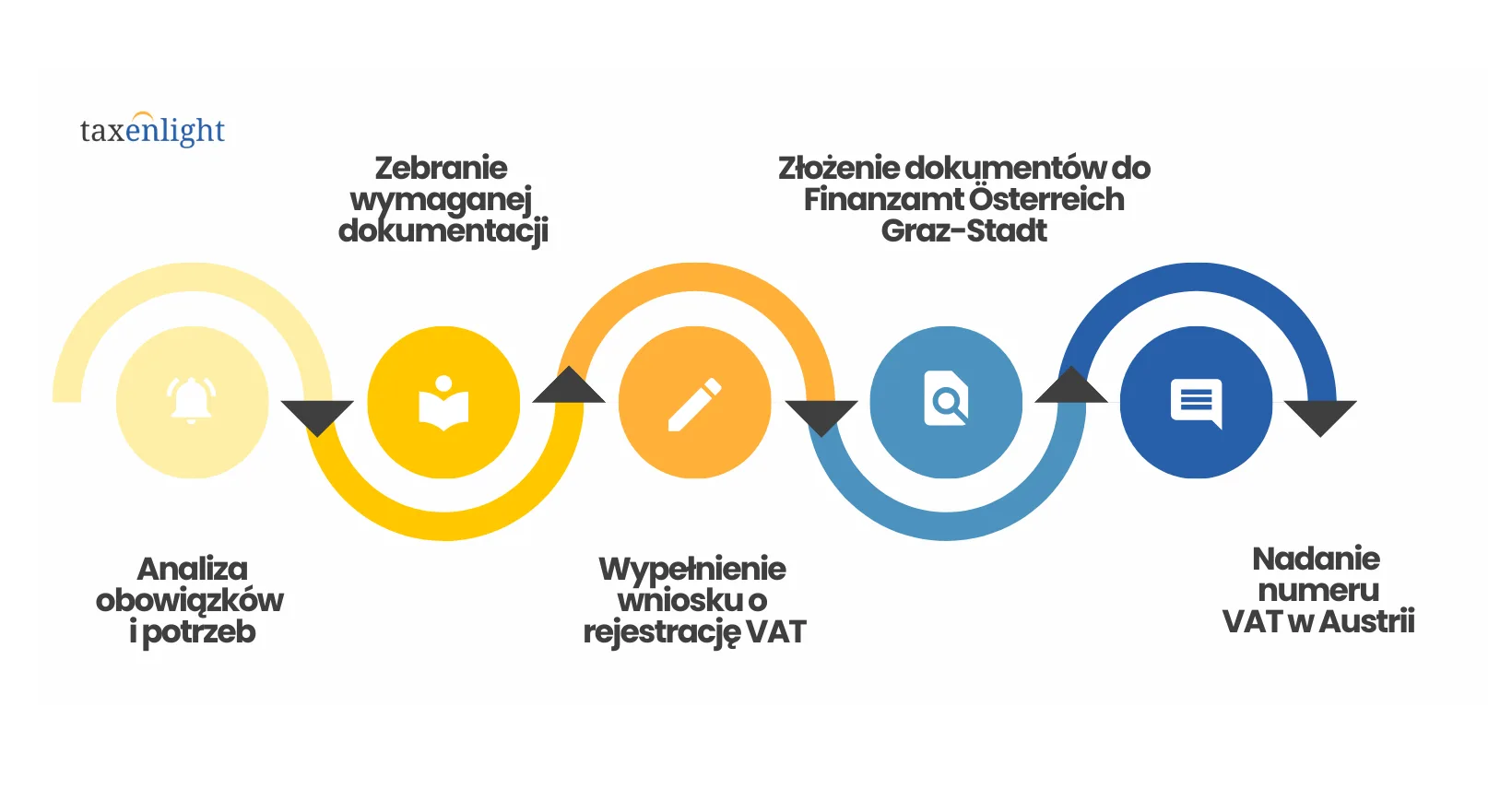
The Austrian VAT number has the prefix ATU and eight digits. Details on the documents, the Verf19 form, the relevant authority, and the procedure for obtaining a UID are available in a separate guide.
Check VAT registration in Austria and the procedure for obtaining a UID number
Not sure if you need a UID number?
We will analyze the warehouse, delivery direction, import, OSS, SME and reverse charge.
Schedule a free consultationCross-border SME exemption in Austria
From 2025, a company based in another EU country can benefit from the small business exemption in Austria after registering in the country of its registered office and obtaining a number ending with -EX.
Three key conditions
- €55,000 – turnover limit in Austria for the previous and current year;
- €100,000 – EU-wide annual turnover limit for the previous and current year;
- -EX number - the exemption is only effective after it has been granted by the country of establishment.
The exemption does not work automatically
A 10% tolerance may apply for exceeding the Austrian limit, but there is no corresponding tolerance for the EU limit of €100,000. The full notification procedure and the consequences of exceeding the limits are described in the registration article.
Check detailed information about VAT declarations in Austria
We've gathered detailed requirements, procedures, exceptions, and error correction rules in one easy-to-read place. Avoid penalties and ensure you're meeting all local obligations.
What does the current settlement of Austrian VAT look like?
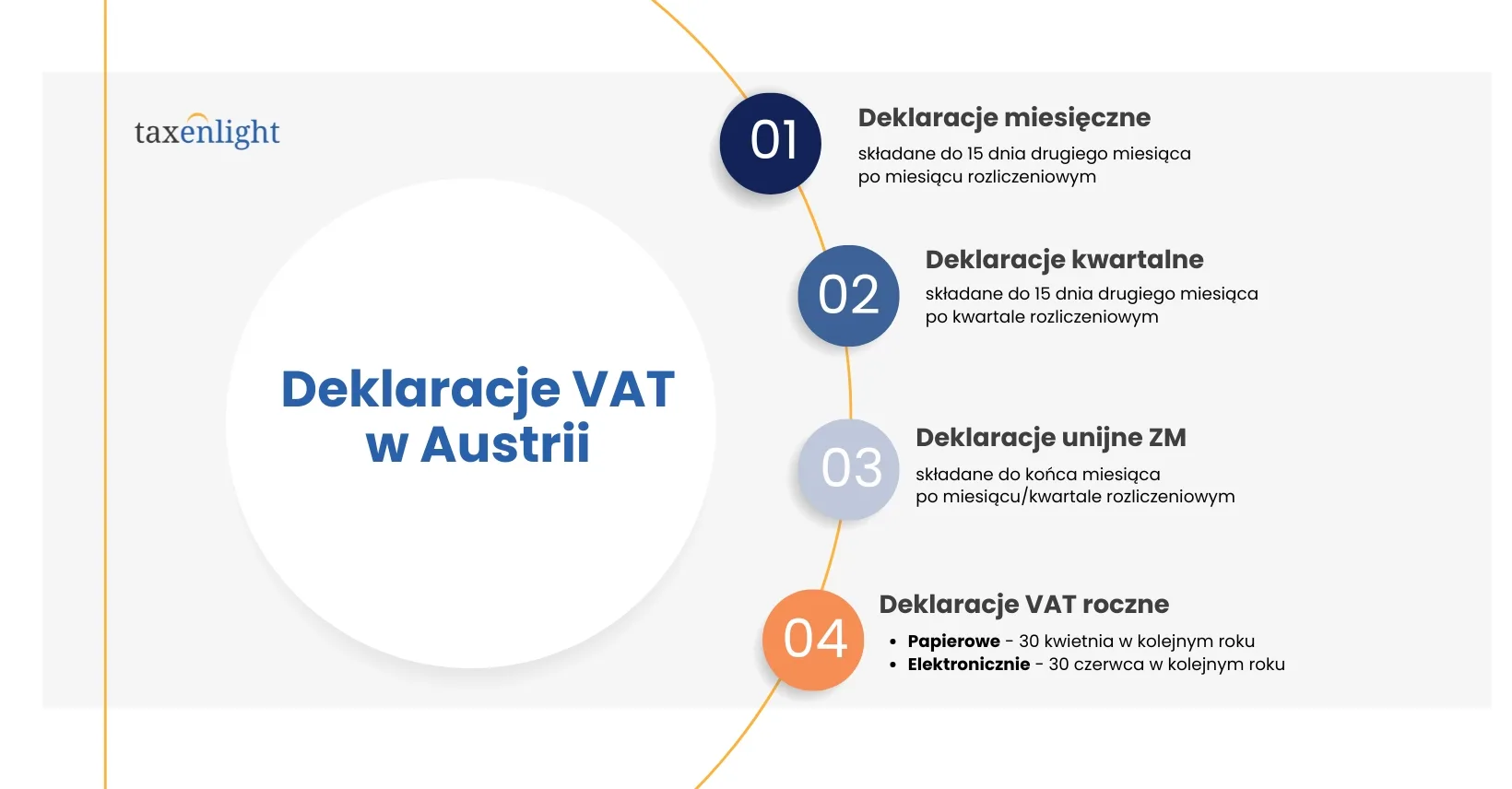
A VAT-registered company can submit periodic UVA returns and an annual U1 declaration. The frequency, deadlines, and possible exceptions depend on the turnover and status of the individual taxpayer.
UVA
UVA is used to periodically report output and input VAT. The timing and obligation to submit the form must be assessed according to the rules specific to the given taxpayer.
U1
The annual return is assessed separately from the UVA. The absence of transactions during a given period does not automatically mean that all obligations are discharged.
INTRASTAT 2026
The thresholds changed in 2026: €5,000,000 for intra-EU imports and €1,200,000 for intra-EU exports. Detailed deadlines and RTIC reporting are described in the declaration article.
The absence of transactions does not automatically mean that all obligations are discharged. The possibility of not submitting periodic UVA depends on the conditions for a specific taxpayer, while the annual return and OSS obligations should be assessed separately.
Invoices and e-invoices in Austria
The invoice should reflect the correct rate and transaction settlement method. From July 1, 2026, goods moving from the 10% rate to 4.9% require special attention.
Move the table sideways
| Area | The most important rule | What to check |
|---|---|---|
| VAT rate | The classification of the goods determines whether 4.9% or 10% applies from 1 July 2026. | Delivery time, advance payments, adjustments and returns. |
| Reverse charge | An invoice without Austrian VAT is only valid if the mechanism actually applies. | Purchaser status, place of taxation and required designation. |
| E-invoices | In 2026, there is no general obligation to use e-invoicing for all B2B transactions. | Separate rules apply primarily to invoices for the Austrian federal administration. |
Check out the guide to VAT registration in Austria
Want to know when VAT registration is mandatory in Austria, what documents you need to prepare, and what the entire process looks like? We've compiled this guide, which explains the registration rules for foreign companies step by step.
VAT refund in Austria – when and how to get the tax back?
Deducting Austrian VAT is only possible for purchases directly related to your business activity in Austria. For a VAT refund application to be accepted by the tax office, invoices must be properly issued and contain all required information. Key requirements for deducting VAT in Austria:
- Invoices must be issued to your company details and relate to goods or services purchased in Austria
- Purchases must be used for business purposes at least 10%
- Taxpayers with a turnover below EUR 2 million can only deduct VAT after payment (with some exceptions)
How to recover VAT in Austria?
Companies without a VAT number can apply for a VAT refund through EU (VAT-REF) or national procedures, depending on the company's registered office
Companies with an Austrian VAT number submit their application online or on paper to the Austrian tax office
OSS and B2C sales to Austria
The €10,000 limit is a single overall limit for the entire EU, not a separate limit for Austria. It covers intra-Community distance sales of goods and certain B2C services, generally when the trader is based in only one EU country.
VAT in the consumer's country
Once the total limit is exceeded, VAT is generally due in the consumer's country and can be settled through the OSS or local registration.
Warehouse, import and own goods
The limit does not apply to sales from a warehouse located in Austria. OSS does not account for imports or non-transactional movements of its own goods to an Austrian warehouse.
OSS can reduce the number of local registrations for typical remote sales, but it does not replace an Austrian VAT number in every situation. Check out OSS VAT return processing and VAT registration in Austria.

Do you have questions about VAT in Austria?
I'll be the one to discuss your VAT situation. Together, we'll determine your company's obligations and the next step.
Goods storage in Austria
The types of warehouses in Austria used by entrepreneurs include:.
Call-off stock warehouses where goods are stored and sold on demand
Own or outsourced warehouses
Warehouses run in the 3PL model, where you entrust all logistics and delivery services to external logistics operators
Using the services of the above-mentioned warehouses in certain situations requires identification with an Austrian VAT number, regardless of whether you also use the OSS procedure.
In Austria, local marketplaces operate, enabling sales through their platforms. Sellers then outsource logistics to external warehouses using a 3PL model (with a narrower scope than Amazon FBA). These have warehouses in Austria. These platforms and stores include:
- Universal.at
- Galaxus.at
- Willhaben.at
- Otto.at
- Niceshops.com
Reverse charge in Austria – B2B services, exceptions and VAT obligations
Reverse charge in Austria means that in certain cases, the obligation to settle VAT shifts from the supplier to the recipient of the service. In B2B transactions with an Austrian contractor, the recipient can report the VAT on their tax return and then, if they meet the conditions, deduct it on their side.
What is the general principle of reverse charge in Austria?
Generally, B2B services are taxed where the buyer's registered office is located. In practice, this means that if a Polish company provides a service to a company registered for VAT in Austria, the Austrian recipient may be responsible for settling the tax.
Thanks to this, a Polish service provider often does not have to charge Austrian VAT on the invoice or go through VAT registration in Austria, as long as the service in question falls within the general rule and does not fall into the list of exceptions.
If you're issuing a reverse charge invoice, provide only the net, omit the local VAT rate, and clearly state the reverse charge mechanism. In practice, it's also worth providing the legal basis to reduce the risk of the document being challenged.
How does this work in practice?
- 1
The place of supply of the service is Austria.
- 2
The Polish supplier issues an invoice without Austrian VAT.
- 3
The Austrian buyer himself reports VAT in his settlement.
- 4
If the service is fully subject to reverse charge, the Polish entrepreneur is usually not required to have a local VAT number in Austria.
When can reverse charge be applied in Austria?
The reverse charge mechanism operates when Austrian regulations shift the obligation to settle VAT to the purchaser and the transaction in question does not fall within the exceptions requiring local settlement by the service provider.
- Construction and assembly works – when a foreign company performs work in Austria for a taxpayer using an Austrian VAT number.
- Trade in metals, scrap and waste – in selected transactions involving secondary raw materials and materials for recycling.
- Selected high-value goods – e.g. certain processors, chips, phones or tablets when local conditions are met.
- CO₂ emission allowances and similar rights – when the regulations provide for VAT settlement on the part of the purchaser.
The most important exceptions to the general rules
Reverse charge in Austria does not apply to all B2B services. In some cases, the foreign service provider must still charge local VAT and obtain an Austrian VAT number.
- Real estate services – e.g. management, rental or some advisory services regarding a specific property in Austria.
- Passenger transport – VAT is settled according to the rules applicable to the section of the route running through Austria.
- Catering and restaurant services – the place of taxation is usually the place where the service is actually performed.
- Trade fairs, conferences, events and exhibitions – some event-related services in Austria are subject to local VAT.
Import VAT in Austria
When importing from a third country, the Austrian EUSt import tax is levied. The basis is generally the customs value plus appropriate duties and costs.
The importer can pay the EUSt to the customs office and then deduct it at the UVA or – if the conditions are met – settle the tax monthly through the tax account maintained by the Finanzamt.
Settlement via tax account - the most important conditions
The solution under § 26 paragraph 3 UStG is not an automatic “postponement” available to every importer.
The importer is registered for VAT in Austria.
Goods are imported for business purposes.
The customs declaration and EUSt accounting were correctly marked.
Not sure what VAT obligations apply to your company in Austria?
We will help you determine whether you need VAT registration, what documents to prepare and which declarations to submit.
Summary
In 2026, the VAT analysis in Austria must start with the correct rate, place of taxation and who is to settle the tax.
An OSS can simplify the settlement of certain B2C sales, and an SME can allow a company from another EU country to benefit from the exemption after meeting the limits and obtaining an -EX number. Neither of these systems replaces the analysis of warehouse, import, own goods movements, or transactions without reverse charge.
We describe the detailed procedure for obtaining a UID in our registration guide, and the terms UVA, U1, and INTRASTAT in our declaration guide. If you're unsure which obligation applies to your company, contact Taxenlight.
FAQ – most frequently asked questions about VAT in Austria
The standard VAT rate is 20%. Reduced rates are 13%, 10%, and—from July 1, 2026—4.9% for selected basic food products. The rate is always set for the specific good or service.
Austria introduced a flat rate of 4.9% for selected food products identified by tariff classification. The change did not automatically apply to all food products.
The 4.9% rate applies only to products listed in the new regulations. Other goods, including some foods, may continue to be subject to the 10% rate. The classification of the product, not the general category of "food," is decisive.
Yes, provided the following conditions are met: the turnover in Austria cannot exceed EUR 55,000, the turnover in the entire EU cannot exceed EUR 100,000, and the company must first register in Poland and obtain a number ending with -EX.
Not in every situation. OSS can account for certain B2C sales, but does not cover the import or movement of your own goods. Warehouse and local sales in Austria may still require a UID number.
Reverse charge only applies when the law shifts the obligation to settle VAT to the buyer for a given transaction. It is not an automatic rule for every B2B sale.
Yes. The movement of goods into and from an Austrian warehouse must be analyzed independently of the OSS. This often leads to local VAT registration and reporting.
A company with an Austrian VAT number generally deducts tax in its local tax return. A company without local registration may use the appropriate refund procedure, such as VAT-REF for EU entities, if it meets the conditions.
Not automatically. The ability to opt out of UVA depends on the taxpayer's specific circumstances; the annual return is assessed separately, and nil returns are required in the OSS system.